- 435-673-6350
- advisors@staterawealth.com


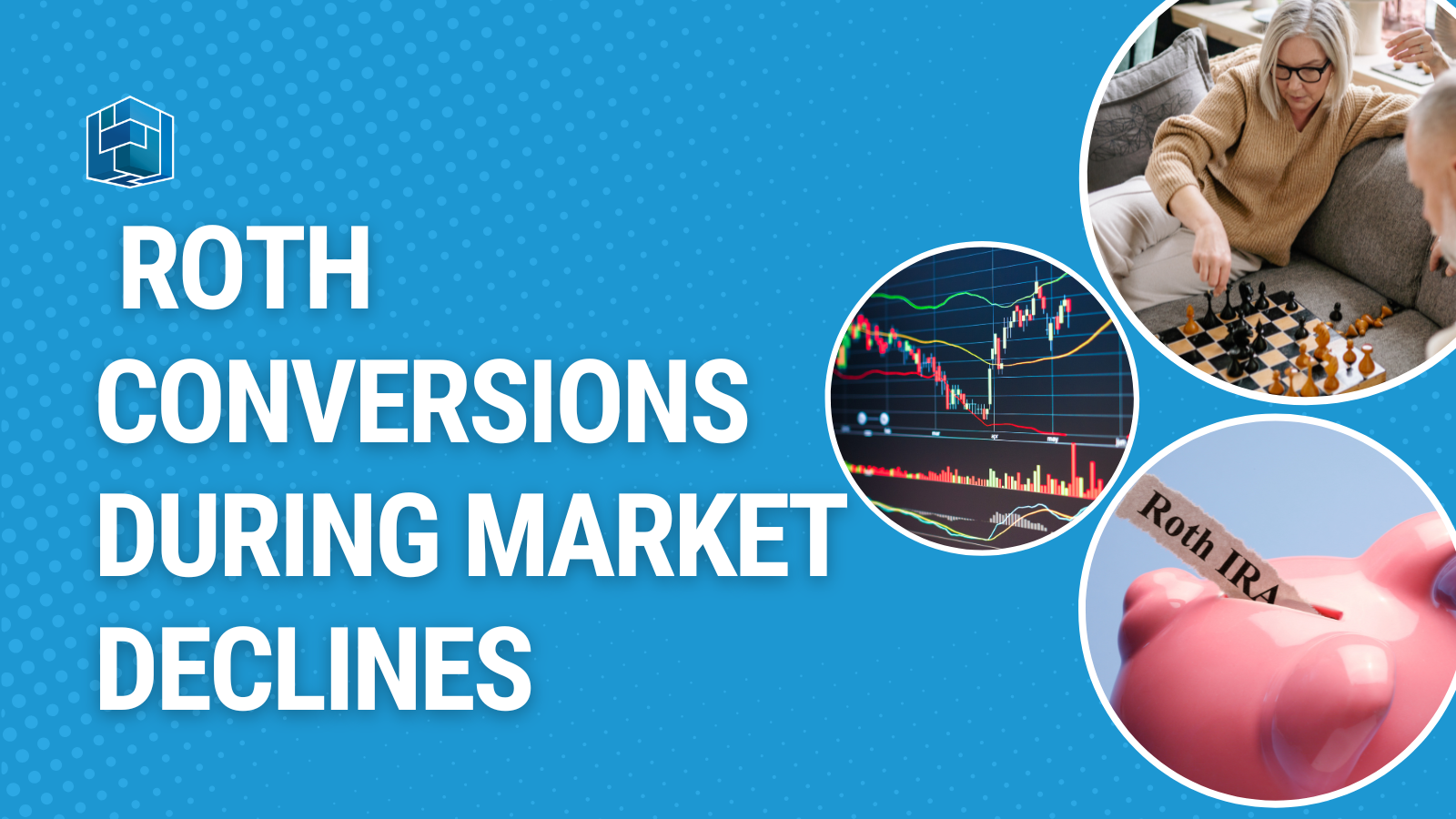
Market declines create discomfort, uncertainty, and sometimes opportunity. One potential opportunity is a Roth conversion.
When investments inside a traditional IRA decline in value, the tax cost of converting a specific investment position may be lower. If the assets later recover inside the Roth account, the recovery may occur without future federal income tax on qualified withdrawals. The same decline can also reduce projected future Required Minimum Distributions.
That logic is valid, but incomplete. A lower market is not automatically a signal to convert. The household still needs an appropriate tax rate, sufficient cash to pay the tax, a long time horizon, and a portfolio that remains suitable. The conversion should be a tax-planning decision supported by the investment plan—not a prediction that the market has reached the bottom.
Assume an investor owns 2,000 shares of a diversified fund inside a traditional IRA. At $50 per share, converting the position creates $100,000 of gross conversion income. After a decline to $40 per share, the same 2,000 shares are worth $80,000.
If the investor converts the shares at the lower value, the taxable conversion amount is reduced by $20,000. If the fund later returns to $50 inside the Roth, the $20,000 recovery occurs in the Roth environment.
The example does not guarantee a recovery. The fund could decline further, remain depressed for years, or fail to meet expectations. The planning advantage is simply that the investor moved more shares per taxable dollar at the time of conversion.
Investors often think of conversions only as dollar amounts. During a decline, it can be useful to think in terms of assets or shares.
A $75,000 conversion may move more shares after a 25% decline than before the decline. If the household intends to hold those shares long term, the Roth receives a larger portion of the future return potential.
This approach should not lead to converting speculative or unsuitable holdings. A conversion does not improve the quality of an investment. If a position no longer belongs in the portfolio, the correct decision may be to sell or rebalance rather than preserve it inside a Roth.
A lower account value does not repair an unfavorable tax bracket. A high-income investor who converts during a decline may still pay a high federal and state rate. The market opportunity and tax opportunity must overlap.
The conversion amount should be tested against ordinary brackets, capital-gain interactions, Medicare IRMAA, Social Security taxation, and other income-based rules. The all-in marginal cost matters.
Market declines often occur during recessions, job losses, or business slowdowns. Liquidity may be more valuable precisely when the conversion appears attractive.
The strongest conversions are generally funded with cash outside the IRA. If paying the tax would drain emergency reserves, require a taxable sale at a loss, or force borrowing, the household may be taking too much risk.
The benefit comes from future tax-free compounding and reduced taxable distributions. If the converted assets will be spent soon, there may be little time to recover the upfront tax cost.
The strategy is more compelling for assets intended for later retirement or heirs than for assets earmarked for next year’s living expenses.
No one knows the market bottom in real time. Waiting for certainty usually means waiting until prices have already recovered.
A practical alternative is to convert in tranches. For example, a household with a $120,000 annual conversion target might complete four $30,000 conversions at different points during the year. If the market continues falling, later tranches occur at lower values. If it recovers, part of the planned conversion was already completed.
Tranching also improves tax control. The final amount can be adjusted after year-end income, capital gains, and deductions become clearer.
The purpose is not to produce the lowest possible conversion price. It is to reduce the risk of making one irreversible decision at one uncertain point.
A conversion can be coordinated with portfolio rebalancing. Suppose a household is underweight equities after a decline. The advisor may convert selected growth assets to the Roth, where future appreciation has greater tax value, while maintaining stable assets in traditional accounts for near-term distributions.
Asset location should not override diversification or liquidity. But when the household already needs to rebalance, the conversion can help place higher-expected-return assets in the account where future qualified growth is tax-free.
Transaction procedures matter. The conversion can often be completed in kind, meaning the investment moves from the traditional IRA to the Roth without being sold. The custodian reports the fair market value at conversion. Alternatively, assets may be sold and cash converted. The choice depends on custodian capabilities, portfolio design, and execution risk.
Because current law generally does not allow a Roth conversion to be recharacterized, an investor cannot reverse the transaction merely because the converted investment falls afterward.
If $100,000 is converted and the Roth later falls to $75,000, the investor still generally reports the $100,000 conversion. That is psychologically difficult and one reason to avoid oversized, one-time conversions.
The possibility of further decline should be built into the decision. A household that can accept the tax result and hold the assets long term is better positioned than one that will regret the conversion after another difficult month.
A lower traditional IRA balance can reduce future RMDs, but one conversion rarely solves the entire RMD problem. The household should project the account over many years using reasonable growth and withdrawal assumptions.
For someone already subject to RMDs, the required amount for the year generally cannot be converted. The RMD must be distributed before eligible remaining amounts are converted. This sequencing should be coordinated with the custodian and tax professional.
A retiree who gives to charity may also use Qualified Charitable Distributions for eligible gifts. Traditional IRA dollars intended for charity may be more tax-efficient left unconverted.
Consider two retirees, each with a $1.5 million traditional IRA and the same tax bracket. Both intend to convert $100,000.
Retiree A converts before a 20% market decline. Retiree B converts an equivalent group of diversified holdings after the decline, when the holdings are worth $80,000. Retiree B can either convert the same shares for less taxable income or convert additional shares while keeping gross conversion income near $100,000.
If the market ultimately recovers, Retiree B has shifted more recovery potential into the Roth per tax dollar. If the market does not recover, the expected advantage does not materialize. The investment outcome remains uncertain; the tax amount at conversion is known.
The first error is acting from fear of “missing the opportunity.” Tax planning should not become panic buying inside a Roth.
The second is converting a concentrated position because it declined. A loss can reveal that the portfolio was too risky. Moving the same concentration to a Roth preserves the risk.
The third is ignoring estimated taxes. A conversion completed during a crisis still creates a tax obligation.
The fourth is converting so aggressively that the household cannot rebalance or maintain spending reserves.
The fifth is measuring success by what the market does next month. A Roth conversion is usually a multi-year or multi-decade decision.
Tax-loss harvesting in a taxable account can be valuable, but investors should not assume that a large capital loss will fully offset Roth conversion income. Capital losses generally offset capital gains, plus only a limited amount of ordinary income each year, with unused amounts carried forward under applicable rules.
The market decline can improve a conversion in two separate ways: lower IRA values may allow more shares to move per taxable dollar, and taxable-account losses may help manage capital gains elsewhere. Those benefits should be calculated separately.
A Roth account is often a desirable location for assets with higher expected long-term returns because qualified growth is tax-free. That principle must be balanced against diversification and risk.
During a decline, an investor might convert broad equity funds, small-company exposure, or other growth assets that remain appropriate. Stable assets may remain in the traditional IRA to support future distributions. However, placing all volatile assets in the Roth can make the household’s account-level statements look unbalanced and can create behavioral stress.
The allocation should be evaluated across the entire household. Account location is secondary to the overall risk target.
The taxable amount is generally based on the fair market value of the assets when the conversion is completed. Market movement between the instruction date and completion date can change the reported amount. In-kind transfers, trade settlement, and custodian processing times should be understood.
This can be helpful or frustrating in a fast market. A conversion expected to be $75,000 may be reported at a different value by completion. A tax projection should retain a buffer rather than assume perfect execution.
For large conversions, the advisor and custodian should confirm whether the transfer will occur as shares, cash, or a combination. Documentation should identify the accounts and date clearly.
A household may approve a tax range—for example, $70,000 to $100,000—based on the annual plan. Market conditions can influence where within that range the final conversion lands.
If the market falls materially and liquidity remains strong, the household may convert near the upper end. If income rises unexpectedly or the market recovers sharply, it may remain near the lower end. This approach respects both the tax plan and market uncertainty.
Failing to convert does not mean the recovery is lost. The assets still participate in the market inside the traditional IRA. The difference is the future tax character and RMD impact.
This is important psychologically. A retiree should not feel compelled to convert merely to “capture the rebound.” The rebound can occur in either account. The conversion determines who shares in the future value—the family alone in a qualified Roth distribution, or the family and the government through future traditional-account taxation.
Market declines can improve Roth conversion economics because lower values allow more assets to move for the same taxable amount. But the market is only one side of the decision.
The strongest opportunity occurs when four conditions meet: the assets are temporarily lower, the current effective tax rate is acceptable, the household has outside cash to pay the tax, and the investment horizon is long.
When those conditions exist, a staged conversion can turn volatility into a planning opportunity. When they do not, patience is not failure. The goal is not to exploit every decline. It is to make decisions that strengthen the entire fiscal house.
In one sentence: the conversion amount and timing should improve the whole financial plan.
Use tranches to reduce the risk of one irreversible conversion at one uncertain price.
Sources
Primary references reviewed for this article:
Important Disclosure
This material is for general educational purposes only and is not individualized investment, legal, accounting, Social Security, or tax advice. Rules change and the appropriate strategy depends on each household’s facts. Statera Wealth Management is not a law firm or accounting firm. Consult qualified tax and legal professionals before acting. Investing involves risk, including possible loss of principal. Hypothetical examples are illustrative and do not represent actual results.